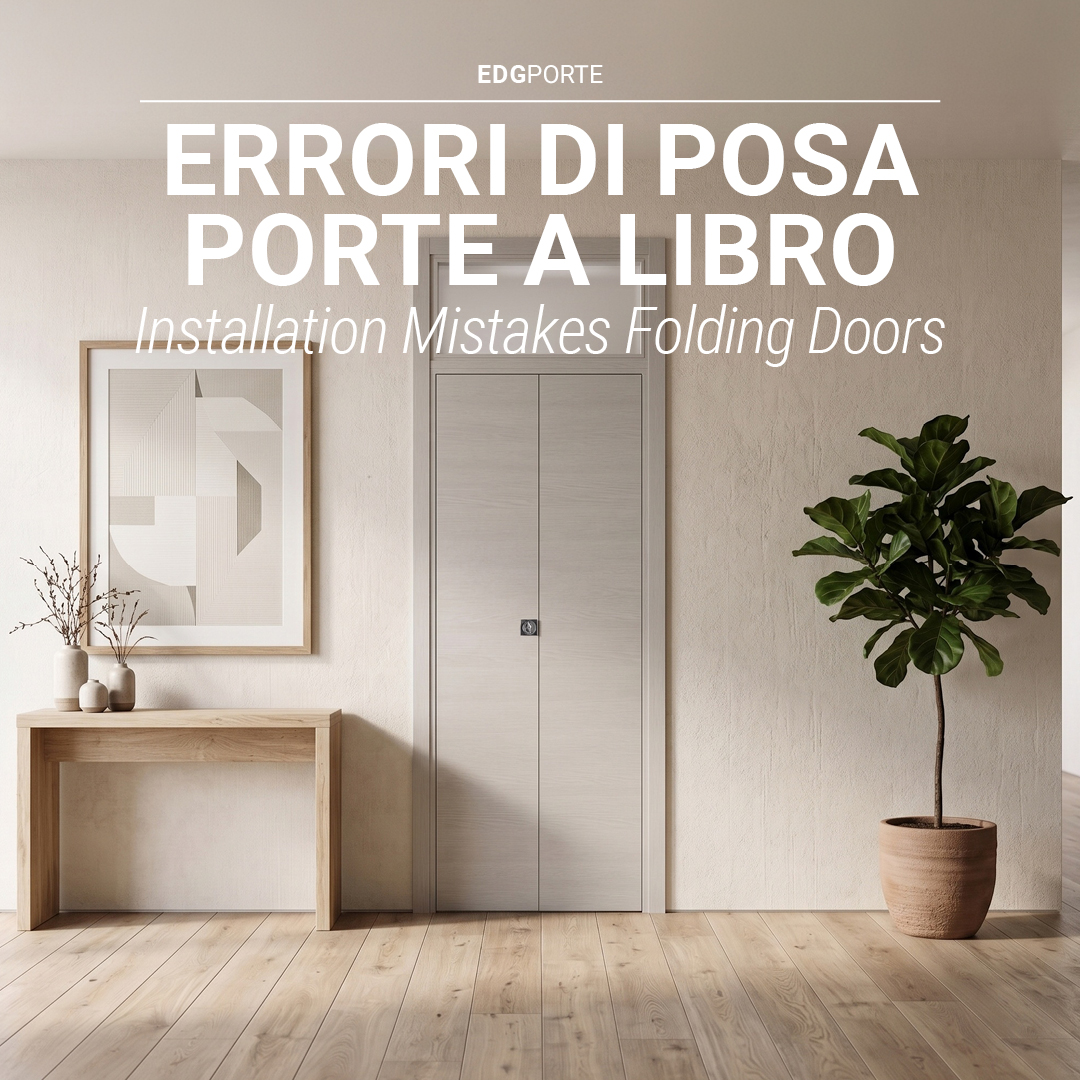
Folding doors: 4 common mistakes still made too often
12 May 2026
Today, the folding door is one of the most requested solutions in residential design projects. It works where a pocket sliding door is not feasible, saves space in hallways and bathrooms, and in more contemporary interiors it can even visually disappear into the environment, becoming part of the interior architecture.
Yet in practice, it is also one of the door types most commonly associated with post-installation issues. Not because it is a difficult product, but because certain design choices are often made too hastily: measurements taken too quickly, variants selected by exclusion, or the actual usage context not fully considered. These four mistakes occur with surprising frequency. Knowing them in advance is the fastest way to avoid having to fix them once the work is already underway.
1. Failing to calculate the actual clear opening width
This is the most common mistake, and also the one that causes the most dissatisfaction. When referring to an 80 cm door, this means the rough opening size — not the actual clear passage width once the folding door is installed. As the two panels fold against each other, they occupy space inside the opening itself. The result is that the usable clear opening is reduced on average by 9–10 cm compared to the nominal size.
In a hallway with a 70 cm opening, after installing a folding door, the actual passage width is around 60 cm. In some contexts — such as a renovated bathroom with fixtures already installed, or an access opening to a sleeping area — this can become a real issue.
The solution is simple: calculate this during the design phase, not after the door has already been ordered. If the clear opening width is a fixed requirement, the opening must be sized accordingly, or a different opening system should be considered.
2. Choosing the wrong variant
Symmetrical, asymmetrical, and sliding folding doors are not equivalent versions of the same product. Each one is designed for a specific usage context, and choosing the wrong option leads to functional compromises that only become apparent once the door is installed.
- The symmetrical folding door divides the leaf into two equal panels. It folds completely to one side, freeing the passage area, but requires recessed ring handles — a detail that some users find inconvenient in everyday use, especially in high-traffic areas such as kitchens or main hallways. It is the most compact version and ideal for narrow openings.
- The asymmetrical folding door retains a traditional handle and lock system, making it feel more similar to a standard hinged door in everyday use. The compromise is that a small portion of the leaf still occupies space on the outer side, which must be considered when both adjacent areas need to remain free of obstructions.
- The sliding folding door is the most sophisticated solution: the leaf folds while sliding laterally toward the wall, maintaining the full clear opening width. The space-saving advantage is significant, but the mechanical system is more complex and installation requires greater precision.
The choice is never purely aesthetic. It depends on who uses the door, how frequently it is used, and how much space is available on both sides of the opening.
3. Ignoring the floor
This is one of the least intuitive mistakes, yet one of the most frequently reported by professional installers. Unlike a pocket sliding door — which requires a recessed floor track — the folding door does not use a lower guide system. However, this does not mean the floor is irrelevant. Quite the opposite.
During opening and closing, the panels move within a limited floor area, and in the presence of uneven levels, poorly positioned expansion joints, or raised thresholds between the two rooms, the movement can become obstructed or forced. In the most common cases, the panels scrape the floor at one point and jam: a problem frequently seen with laminate flooring, where the expansion joint in the doorway may be too thick for the clearance allowed beneath the lower panel.
Measurements should always include the finished floor level, not just the dimensions of the rough opening. And when renovating a space with existing flooring already installed, it is essential to ensure the door dimensions account for the finished surface already in place.
4. Underestimating the quality of the hinge and track system
A folding door operates through a mechanically more complex movement than a traditional hinged door. Every time the door opens, the panels move on two axes simultaneously: they rotate on the hinges while sliding along the upper track. This means the mechanical components — hinges, tracks, pivots — are subjected to greater stress than a standard hinged door, and the quality of these elements makes a significant difference over time.
A low-quality hinge system gradually leads to a series of problems with use: the panels begin to lose alignment slightly, movement becomes less smooth, noises appear during opening and closing, and in the most severe cases, the system can jam and make the door difficult to operate.
The upper track must be correctly sized according to the weight and dimensions of the panels, and securely fixed to the frame structure. A track mounted on a frame that is not perfectly plumb, or on an unstable surface, transfers mechanical stress directly to the hinge pivots, accelerating wear.
When choosing a folding door, the quality of the mechanical system is at least as important as the finish of the panels. It is the component that determines long-term durability and smooth daily operation.
Design carefully first, install better later
The folding door is an intelligent technical solution, capable of solving real problems in spaces where other opening systems are not practical. It performs well when designed carefully, choosing the right variant for the specific context and correctly sizing every element — from the opening itself to the finished floor level, from the hinges to the track system.
The mistakes we have described are not difficult to avoid. They simply require asking the right questions early on and not treating this type of door as a quick fallback option.
If you are considering a folding door for your project, our team is available to support you in choosing the most suitable solution and ensuring all measurements are correct from the start.
👉 Discover EDG Porte folding collections → https://www.edilgreenlife.com/categoria-prodotto/porte-da-interni/
👉 Contact us for technical consulting → info@masterprofili.com
Share on:
 Strictly necessary cookies
 Functionality cookies
 Tracking cookies
 Targeting and advertising cookies